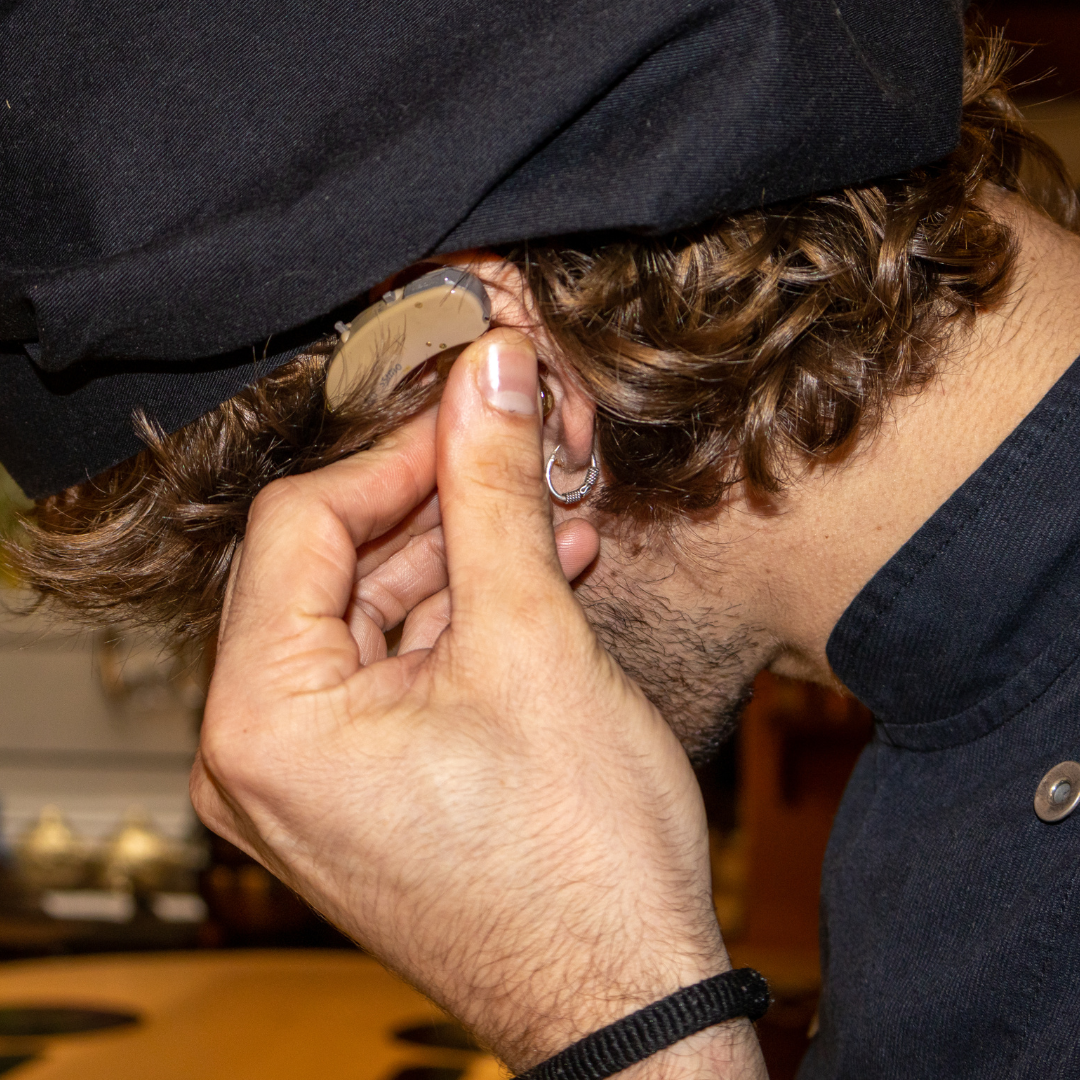
Active restaurant conversations are frequently hard to decipher when surrounding background noise clashes with your hearing. We perform comprehensive diagnostic assessments to evaluate hearing in quiet rooms and challenging acoustic spaces to identify functional deficits. After uncovering the precise factors driving your difficult hearing, our team helps you select individualized auditory solutions.
Explaining Normal Quiet Hearing Versus Restaurant Listening Fatigue
Low-noise environments yield an advantageous signal-to-noise ratio where primary speech remains significantly louder than background sound. Dining rooms present an unfavorable acoustic reversal of this dynamic. Layered diner voices, kitchen activity, foreground music, and room reverberation muddy speech signals, requiring intense mental strain to follow dialogue.
This problem can occur with high-frequency hearing loss, auditory-processing difficulty, or age- and noise-related changes. Attention, fatigue, dim lighting, and distance from the speaker may make it worse. It is common to display normal baseline audibility on conventional hearing tests while failing comprehensive speech-in-noise testing. Communication breakdowns in loud restaurants should be professionally assessed even if one-on-one listening feels uncompromised.
How Is High-Frequency Hearing Loss Diagnosed?
We initiate evaluation by exploring challenging acoustic environments, acoustic trauma history, subjective tinnitus, prescription drug profiles, and unilateral ear changes.
Clinical pure-tone audiometry identifies hearing threshold levels across various frequencies by delivering sounds through air and bone pathways. Patients with high-frequency hearing loss typically exhibit a sloping audiogram configuration where sensitivity steadily declines at elevated pitches. Comprehensive evaluations frequently include impedance tympanometry to examine middle-ear function and recorded word-recognition testing to measure speech understanding.
Given that isolated quiet booths do not reflect chaotic restaurant acoustics, specialized speech-in-noise testing delivers invaluable diagnostic data. It measures how well you recognize words or sentences as competing sounds become louder. In combination, these diagnostic metrics reveal whether communication hurdles involve audibility thresholds, speech discrimination, neural noise management, or mixed conditions.
Auditory Processing Disorders: Impact on Adult Communication
An auditory processing disorder degrades the central nervous system’s capacity to organize and interpret complex sound inputs. While peripheral ears may register soft tones normally, the auditory cortex struggles to filter competing noise, resolve phonetic contrasts, or keep pace with rapid conversation. We first rule out peripheral sensorineural deficits before deciding whether a dedicated auditory-processing test protocol or specialist referral is indicated.
Effective Techniques to Hear Better in Noisy Surroundings
Minor environmental adjustments can boost speech acoustic signals and supply critical visual lip-reading cues. Prior to dining, choose venues known for lower noise levels or schedule meals during quieter dining hours. Restaurants featuring plush booths, wall acoustic panels, heavy drapery, carpeting, and sound-dampening materials provide superior listening compared to open rooms with reflective surfaces.
Practical seating strategies in the dining room:
- Ask for seating positioned far away from open kitchens, noisy bar areas, ceiling speakers, and large parties.
- Position yourself with your back toward a solid partition to dampen intrusive background noise from behind.
- Face your conversation partners in good lighting.
- Reduce physical spacing between yourself and companions to maximize direct speech perception.
- Turn your better-hearing ear toward the specific speaker you want to hear most clearly.
- Instruct conversational partners to reword missed phrases instead of repeating the entire sentence verbatim.
- Validate significant pieces of information directly rather than feigning understanding during dialogue.
- Take a brief listening break when fatigue begins to build.
- Request that friends speak with crisp clarity rather than speeding through dialogue.
- Shouting can distort speech and does not necessarily make words easier to understand.
Advanced Technology for Hearing in Background Noise
Optimal technological solutions depend entirely on the etiology of your symptoms, target acoustic spaces, and whether measurable hearing loss exists. Modern clinical hearing aids integrate directional microphone polar patterns, automated digital noise suppression, and personalized restaurant memory settings to highlight frontal speech and reduce background competition. Users should establish realistic expectations because no hearing device can fully eradicate all unwanted ambient speech.
Wireless remote microphones provide the most effective enhancement to real-world signal-to-noise ratios. Clipped near the speaker’s mouth or set nearby, the transmitter sends voice signals wirelessly to matched hearing aids or a receiver. Direct audio routing minimizes the acoustic penalty of conversational distance and surrounding environmental din.
Additional effective assistive technologies include:
- Omnidirectional table microphones designed for group dining tables
- Telecoil components connecting directly to public hearing-loop systems
- Smartphone live-captioning platforms providing instant speech-to-text visual support
- Earbuds or hearables with compatible assistive-listening features
- Decibel-level applications and restaurant rating guides for finding quiet tables
We analyze suitable devices, verify functional compatibility with your current setup, and guide you through real-world operation.
How Can a Doctor Help with Hearing in Loud Places?
A comprehensive hearing evaluation looks far beyond the common misconception of “I hear fine in quiet environments.” We assess the specific acoustic settings, speaker dynamics, and volume levels that disrupt your hearing to administer targeted evaluations. Clinical evaluation commonly integrates pure-tone audiometric testing, middle-ear analysis, word recognition, and speech-in-noise measures. Auditory-processing testing may be considered when the history and initial results support it.
Sudden, one-sided, or rapidly worsening symptoms may require medical evaluation by an ear, nose, and throat physician. Tailored audiological treatment identifies the exact origin of listening breakdown rather than assuming environmental dining noise is the sole culprit.
Contact Us for a Hearing Evaluation Today
When dining out causes you to guess at words, detach from family, or experience severe listening exhaustion, book a comprehensive hearing evaluation with us. We can evaluate targeted solutions to optimize your hearing in noisy environments using prescription hearing aids, assistive listening technology, or communication strategies tailored to you.
Connect with us today to arrange your clinical visit and take the first step toward clearer, easier dining communication.